Home › Sleep › Menopause & HRT
7 Signs Your 3am Wake-Up Isn't Your HRT at All, And What's Really Waking You
HRT fixed the hot flashes. Not the 3am. Why the sweats went and the wake-ups stayed, and the part of your night that hormone therapy was never built to reach.

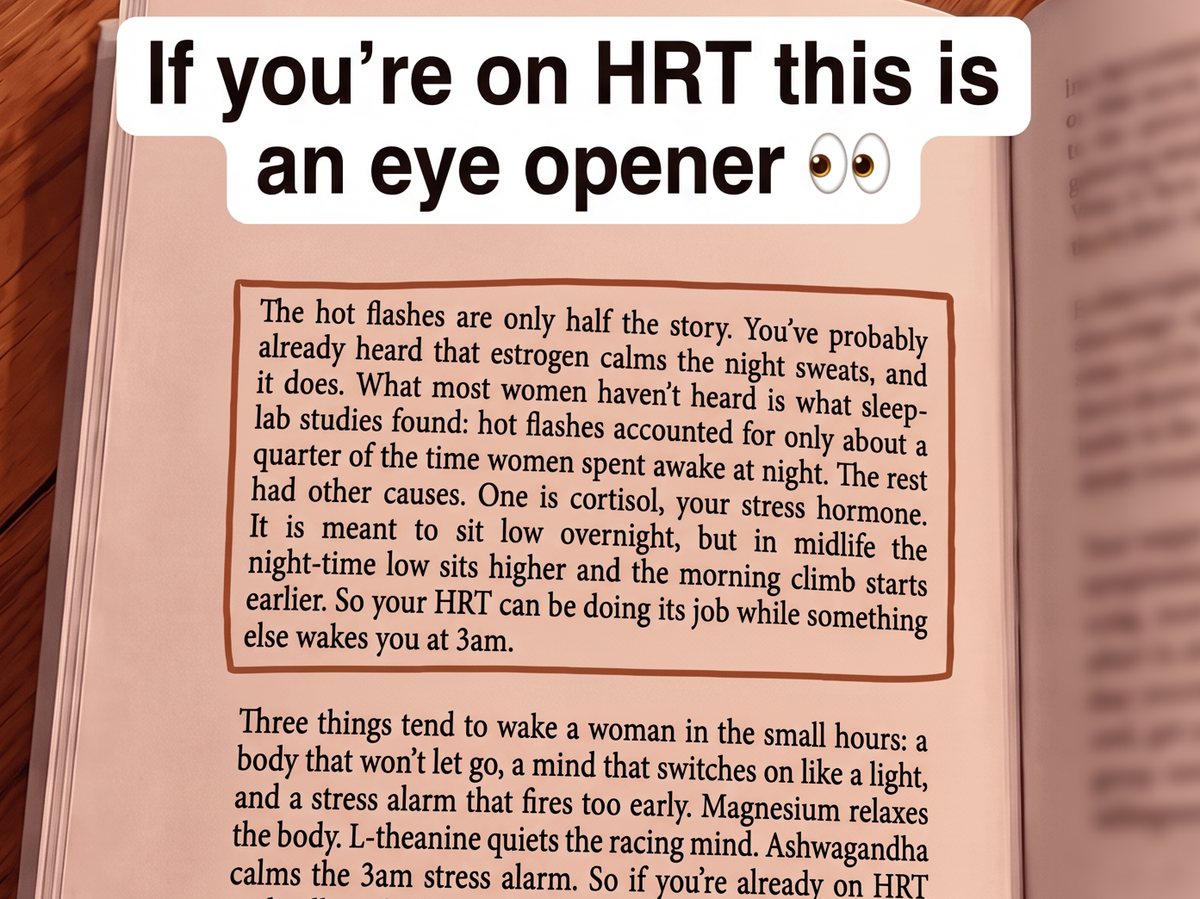
If you're on HRT and you still wake up at 2, 3 or 4 in the morning…
Maybe the patch took your hot flashes within weeks. The night sweats stopped. Your mood lifted, the brain fog cleared, you felt like yourself again in the daytime.
But the 3am stayed.
You fall asleep fine. Then your eyes snap open. Wide awake, heart going, mind already running, even though you're exhausted.
Your doctor raised your progesterone. Or adjusted your estrogen. Or told you this is just part of this stage of life.
You're not imagining it, and you're far from alone. In the menopause forums it's one of the most repeated lines there is: "I'm on HRT and wake up EVERY SINGLE night at 3am."
For a lot of women, HRT fixes their sleep. This article is for the ones it didn't.
Here's the truth: your HRT is probably doing its job. Something else is waking you at 3am. And hormones were never built to reach it.
And if you're thinking "but I already take magnesium"… keep reading. That's one of the signs too.
Here are 7 signs your 3am isn't your HRT…
The Hot Flashes Are Gone. The 3am Wake-Up Isn't.
The sweats went first. That's what estrogen does best, and yours is doing it.
So why are you still lying there at 3:12 in the morning?
Because hot flashes were only ever part of what wakes a woman at night.
From the research
In a sleep-lab study of women in the menopause transition, 69% of hot flashes did wake women up. But the wake time tied to hot flashes was 16.6 minutes a night, which "accounted for 27.2% of total awake time per night."
Source: de Zambotti, Colrain, Javitz and Baker, Fertility and Sterility, 2014
So roughly three quarters of the time those women lay awake had nothing to do with a hot flash.
HRT can take away the hot flash. It was never designed to take away the other three quarters. That's the part still waking you.
"I'm on HRT and wake up EVERY SINGLE night at 3am. It's SOOOO WEIRD!"r/Menopause, "Waking up at 3 am every single night"
Progesterone Helps You Fall Asleep, Not Stay Asleep
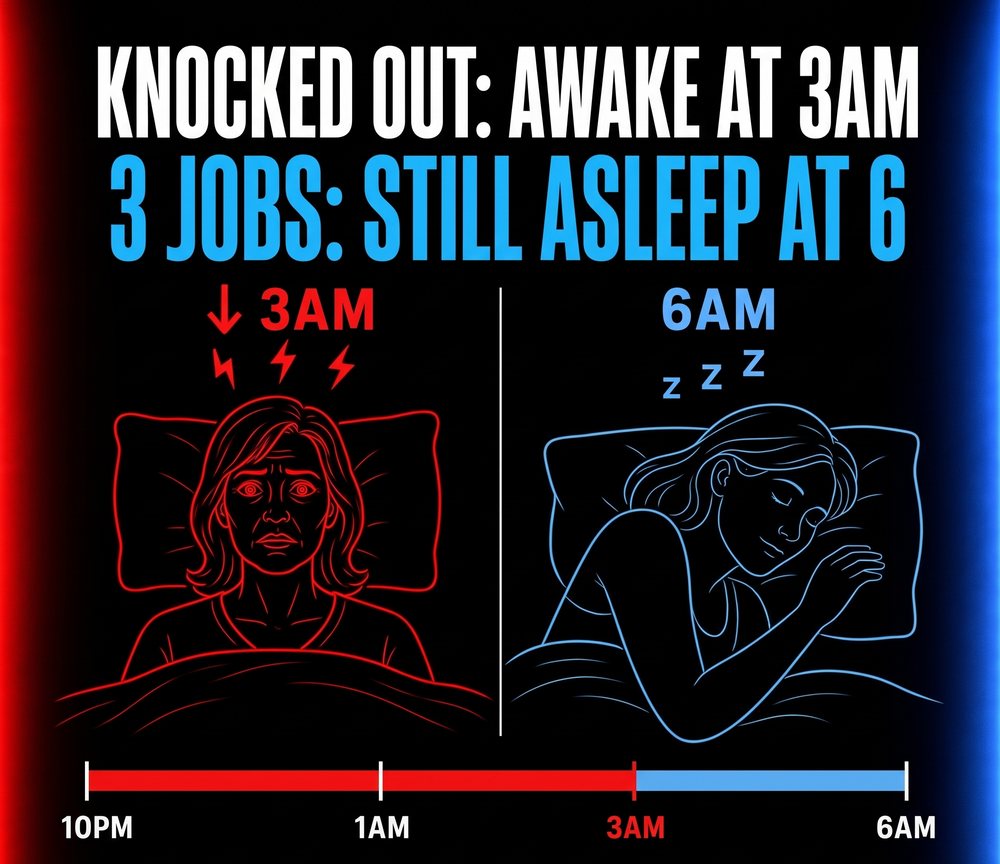
Maybe the first night on progesterone felt like a miracle. Then it didn't last.
"I started at 100mg and the first night was the best night of sleep I'd had in years, maybe a decade. The following night was back to insomnia!"r/Perimenopause, "How fast does progesterone improve sleep?"
You go down easy at 10. Then at 2 or 3 you're up like someone flipped a switch.
That isn't you taking it wrong. It's what progesterone is best at.
From the research
A 2021 review of 9 randomized trials found that progesterone helped women fall asleep faster, but did not improve total sleep time or sleep efficiency.
Source: Nolan, Liang and Cheung, Journal of Clinical Endocrinology & Metabolism, 2021
Women in the forums put it more simply: "progesterone is for falling asleep and estrogen is for staying asleep." So when you're on both and still up at 3, it's worth asking what else is pulling you out of sleep.
"Progesterone is supposed to help you sleep. It helps me fall asleep but not stay asleep."r/Perimenopause, "My sleep is so bad I can't function at work"
You Wake Up Instantly Alert, Heart Racing, Even Though You're Exhausted

Not hot. Not sweaty. Just on.
Heart doing something you can feel. Brain fully booted. Body begging for sleep, and none coming.
"I feel like when I l wake up I'm instantly awake, alert and anxious... even though I'm exhausted."r/Perimenopause, "What worked for the 2-3am abrupt wakeups?"
That isn't a hot flash. That's your stress system.
From the research
Cortisol, your stress hormone, is meant to sit low overnight and climb toward morning. A study of adults aged 20 to 80 found "the level of the nocturnal nadir increased progressively with aging," that the morning peak rose with age in women, and that "the timing of the circadian elevation was advanced."
Source: Van Cauter, Leproult and Kupfer, Journal of Clinical Endocrinology & Metabolism, 1996
In plain English: by midlife, your night-time low sits higher, and your body starts its wake-up climb earlier. So in the small hours you're a little more "on" than you used to be, and it takes far less to tip you all the way awake.
Your HRT replaces estrogen and progesterone. It was never built to turn down that alarm.
You Feel Good on Your Dose. Everything Except Sleep.
Mood, better. Brain fog, lifted. Joints, skin, energy in the day, all better.
And still the 3am.
"Aside from the sleep issue I seem to feel good on this dose... Does anyone else feel good with their dose but still have issues staying asleep? Is this normal?"r/Menopause, "Still waking up at 2 am even with a seemingly good dose"
It's far more normal than anyone tells you.
From the research
A 2017 meta-analysis found hormone therapy "improved sleep quality in women who had vasomotor symptoms at baseline." When women without those symptoms were analyzed separately, "no difference was noted."
Source: Cintron et al., Endocrine, 2017
HRT helps sleep most when hot flashes were what broke it. If your sweats are gone and you're still awake, that's the clue. Your dose is likely right for the job it was given. The 3am is a different job.
Another Dose Change, and You're Told It's "Just Life"

Up a dose. Switch the patch to gel. Another 100mg of progesterone. A few hopeful nights. Then the same 3am.
"Had 5 adjustments to my HRT and my doctor just says it's life."r/Menopause, "The 3am insomnia"
And when you finally hit the ceiling:
"I can't take any more estrogen. Am at the top. However, I am also not scurrying. I'm exhausted, zero energy, but still cannot get back to sleep."r/Menopause, "The 3am insomnia"
Here's what nobody explains. If what wakes you at 3am isn't a hormone problem, no hormone dose can reach it. That's why each change buys a little less than the last.
Keep working with your doctor on your dose. That conversation matters. But the dose was never the whole answer to the 3am.
Already nodding along to 3 or more of these?
See the Gummy Women Take Next to Their HRTYour Brain Goes Wild at 3am About Nothing

The email you forgot. Something your daughter said. What to plant in the garden next spring.
"I woke up the other night panicking about what plants I was going to plant in our front garden next spring. Like, it was some life and death stuff."r/Perimenopause, "3am wake up club"
Women in the 3am club have a name for it: "wired but tired. My brain is tired but I can't yawn and my body is awake."
From the research
Sleep gets lighter with age, with less deep sleep and more easy wake-ups (a meta-analysis of 65 studies). And after months of broken nights, researchers describe night-time stress pulses becoming "a conditioned phenomenon that predisposes one to awaken."
Sources: Ohayon et al., Sleep, 2004; Vargas et al., Sleep Medicine Reviews, 2018
Your brain has learned 3am. It isn't a character flaw. It's a habit your nervous system picked up, and the racing mind is what keeps you up once you're awake.
You Already Tried Magnesium. It Took the Edge Off, Nothing More.
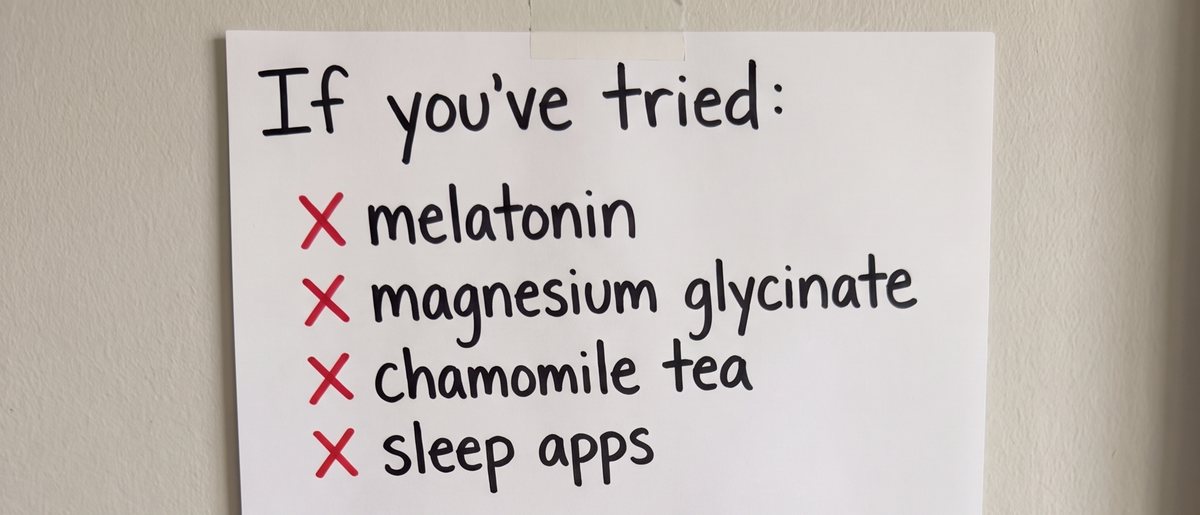
This might be the most frustrating one. You did the reading. There's a bottle of magnesium glycinate on your nightstand right now.
"Nothing has helped: HRT, magnesium glycinate, cutting sugar... you name it, I've tried it."r/Menopause, "Anyone else fall asleep fine but wake up at 3?"
Here's what happened. Magnesium is very good at one job: the body. Muscles let go, legs settle, you drift off.
Worth knowing
In a trial of older adults with insomnia, 500mg of magnesium a night for 8 weeks improved insomnia scores, time to fall asleep and serum cortisol. Early-morning waking improved only marginally (P=0.08).
Source: Abbasi et al., Journal of Research in Medical Sciences, 2012
Your magnesium wasn't wrong. It was doing one job out of three. The racing mind and the 3am stress alarm were never muscles.
Why HRT Can't Reach Your 3am
Your HRT is doing exactly what it was built for. Estrogen is the best treatment there is for hot flashes and night sweats. When those were what woke you, HRT helps, and for many women it's the whole answer.
But three things tend to wake a woman in the small hours, and none of them is a hormone you can patch:
- A body that won't let go. Tense, restless, legs that won't settle.
- A mind that switches on like a light. Replaying, planning, the hamster on the wheel.
- A stress alarm that fires too early. Cortisol starting its morning climb in the small hours, jolting you awake wired.
Your HRT handles the hormones. These three are the rest of the night.
That's why the sweats can be gone and the 3am can stay. And that's why it's so easy to think something is wrong with you, or with your dose.
Nothing is wrong with you. You need something for the part hormones don't reach.
What Women on HRT Are Adding at Night
In the menopause forums, the women who finally sleep through tend to land on the same few things, on top of their HRT, never instead of it:
"I'm on 200 mg progesterone and was still having issues about 3 or 4 nights a week. Starting taking Magnesium nightly about a month ago and I've never slept this good in my life."r/Perimenopause, "My sleep is so bad I can't function at work"
"Firsts it was peri, so I started taking progesterone 100mg. Perfection. Then it was work anxiety. So, I added L-theanine (amino acid) and it calmed that... it just takes the hamster off the wheel so i can sleep if you get me"r/Menopause, "Waking up at 3 am every single night"
"I also take a cortisol support supplement that has ashwaganda in it. It really helps me sleep through the night. I'm also on .075 estradiol patch, 200 progesterone, vaginal Estradiol cream, and 5mg testosterone cream."r/Menopause, "Ashwagandha and HRT"
"Everyone seems to have their magic cocktail, and I'll add mine here: magnesium glycinate + HRT (progesterone at night) + l-theanine."r/Menopause, "Peri and insomnia"
Anonymous public forum posts, quoted as written. They describe each woman's own routine and are not reviews of any product.
Magnesium for the body. L-theanine for the racing mind. Ashwagandha for the alarm. That's three bottles, three jobs, and a lot of pills to line up on the nightstand every night.
So is there one thing that does all three, right next to your HRT?
Sira Magnesium Complex: 3 Jobs, 1 Gummy, Right Next to Your HRT
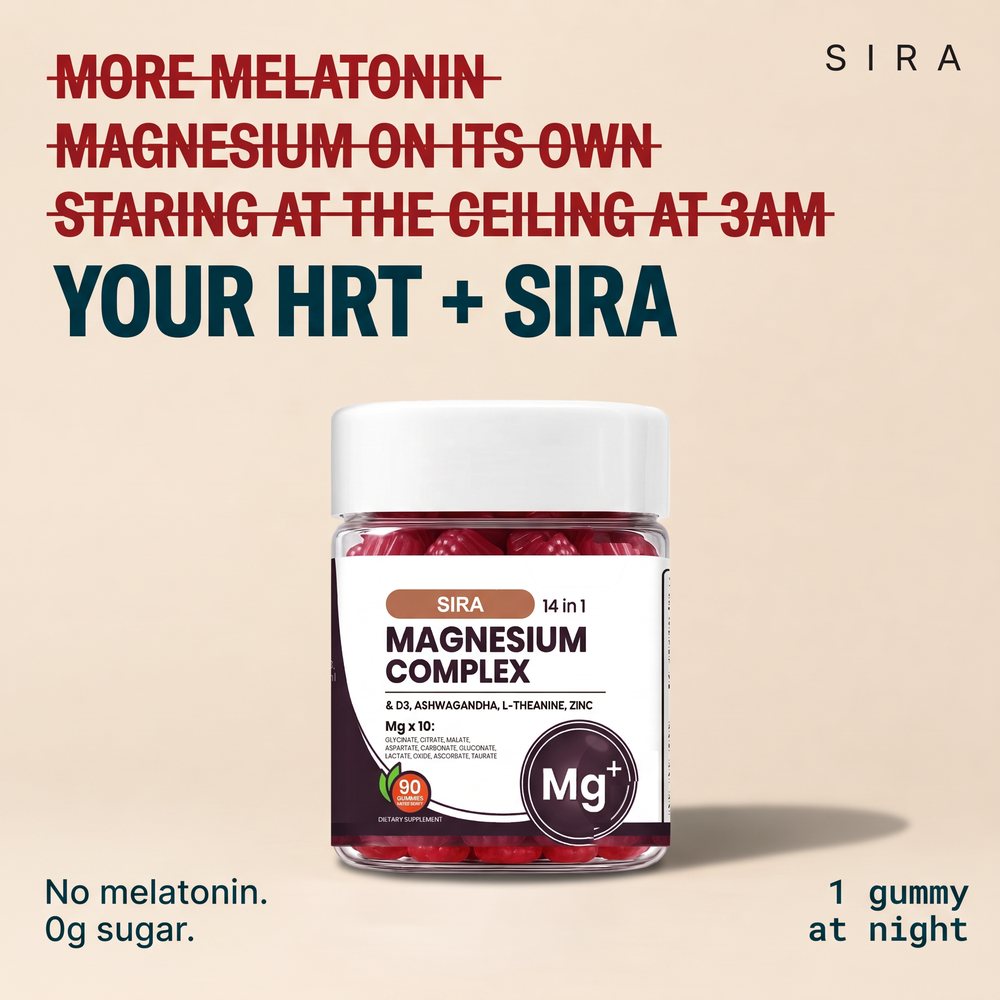
Sira Magnesium Complex puts that stack into one sugar-free gummy you take at night, next to your progesterone. No hormones. No melatonin. Nothing that replaces or changes your prescription. It goes after the part of the night your HRT was never built for.
Job 1 · The body
350mg Magnesium Complex relaxes the body
The part your old magnesium already did, kept in. Muscles let go, restless legs settle, you drift off warm and heavy.
Job 2 · The racing mind
400mg L-theanine takes the hamster off the wheel
A full dose, not the 50mg sprinkle in a drugstore stress gummy. Calm, not knocked out, so if you do stir, your mind doesn't boot up and start planning the garden.

Job 3 · The 3am stress alarm
500mg ashwagandha calms the 3am stress alarm
Once, at night, in one sensible dose. For the wired, heart-going wake-up that no hormone dose touched.
- Hormone-free and melatonin-free. No morning grogginess, nothing that competes with your HRT.
- One gummy, 0g sugar. Mixed berry, raspberry-shaped. No water, no second pill.
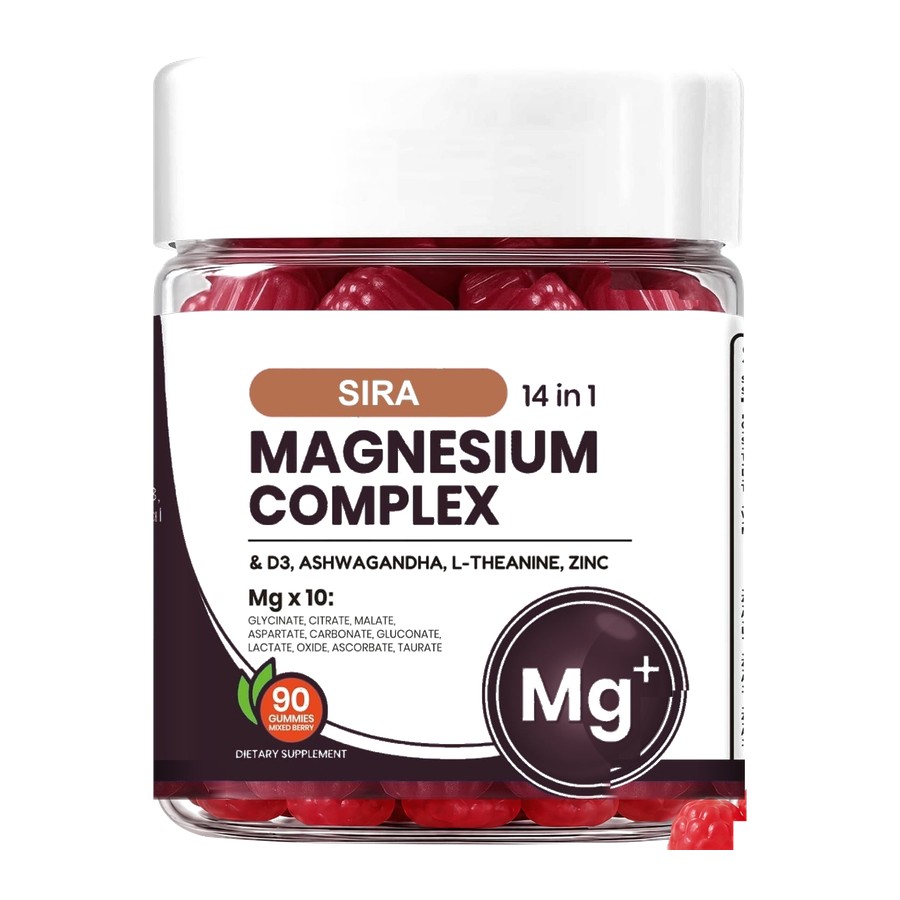
- Every amount printed: 350mg magnesium complex, 400mg L-theanine, 500mg ashwagandha, 2000 IU vitamin D3, 40mg zinc. No proprietary blend.
- No gelatin, no caffeine. 90 gummies, 90 nights a jar.
Your Ashwagandha Questions, Answered Plainly
Magnesium and L-theanine rarely worry anyone. Ashwagandha is the one women on HRT ask about, so here are straight answers.
Does ashwagandha raise estrogen on top of my HRT?
Ashwagandha is a root, not a hormone, and Sira contains no estrogen or progesterone. One small study in perimenopausal women taking 600mg a day for 8 weeks did see estradiol rise (Gopal et al., 2021). Sira has 500mg, once at night. If your estrogen dose is still being fine-tuned, show your prescriber the label. That's the honest answer.
I take thyroid medication. Is that a problem?
Ashwagandha can nudge thyroid hormones. In one trial, 600mg a day for 8 weeks raised T3 and T4 compared with placebo (Sharma et al., 2018). If you take thyroid medication or have a thyroid condition, show your doctor the label before you start.
Will it flatten my mood?
A few people say ashwagandha leaves them feeling flat. Most of the trials that showed benefits used 600mg a day, split into two doses. Sira is a single 500mg dose at night, when you're meant to be winding down anyway. If you ever feel off, stop. You have 60 nights and a full refund either way.
Why once, and why at night?
Because the 3am alarm is a night-time problem. One modest dose, at night, inside a stack. Not twice a day, not four gummies. That's how the women who like ashwagandha tend to take it.
What Changes When the 3am Stops Running Your Nights
Your HRT keeps doing its job. Same patch. Same progesterone. Same doctor.
One gummy goes after the rest: the body that won't let go, the mind that switches on, the alarm that fires too early.
Most women notice the body part in the first few nights: warm, heavy, easier to drift off. The racing mind and the 3am wake-ups loosen over the following two to three weeks of nightly use, which is why Sira gives you 60 nights to judge it.
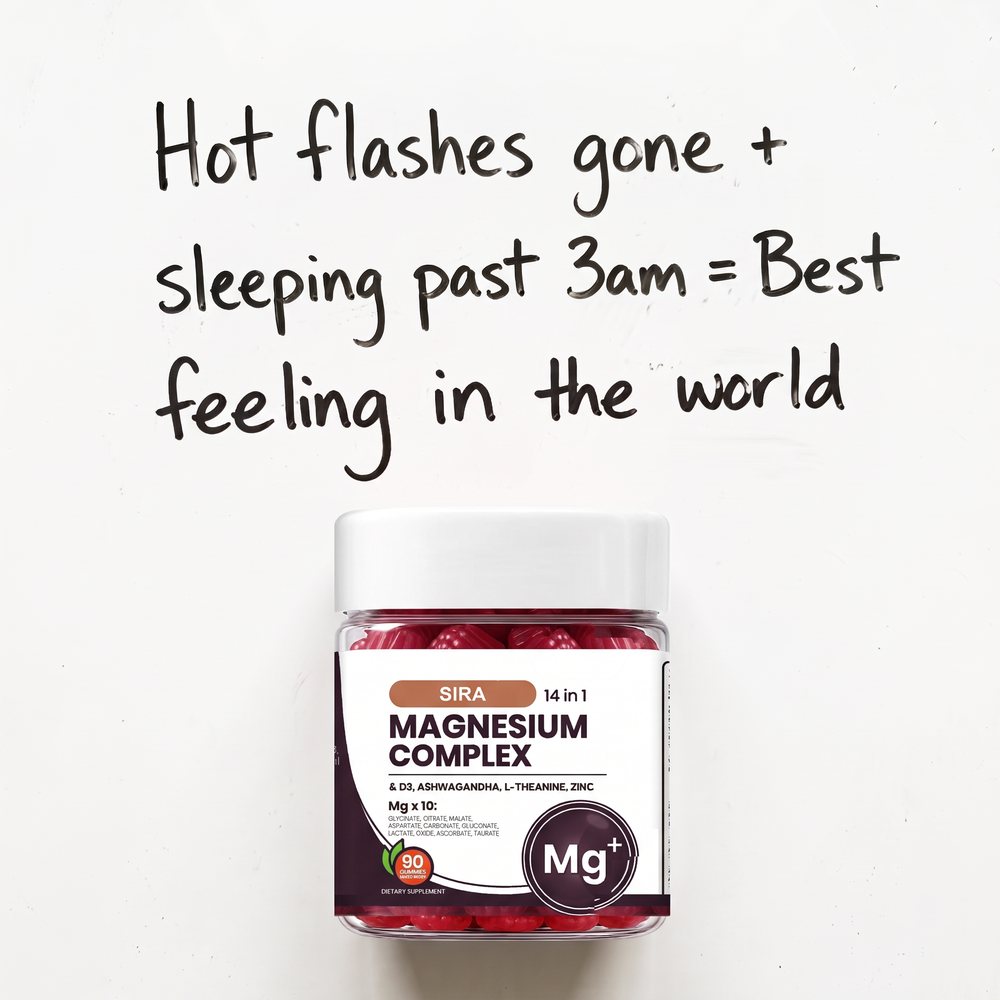
Hot flashes gone. Sleeping past 3am. Waking up to your alarm instead of your heart.
Special Offer for Our Readers
We reached out to Sira and they agreed to extend their best bundle pricing to feedtested readers, with free US shipping.
Your Other Questions, Answered
Do I need to change my HRT?
No. Keep taking your HRT exactly as your prescriber has it, and keep working with your doctor on your dose. Sira isn't a replacement for hormone therapy and doesn't contain any hormones. It's for the part of the night your HRT was never built for.
Can I take it alongside my HRT?
It's hormone-free and melatonin-free, and plenty of women on HRT already take magnesium and L-theanine at night. Taking HRT or thyroid medication? Show the label to your doctor or pharmacist before you start, the same as with any supplement.
Will I wake up groggy?
There's no melatonin in it, which is what most women blame for the next-morning fog. L-theanine calms without sedating, so the goal is waking up to your alarm, not dragging through the morning.
I already take magnesium. Why would this be different?
Because your magnesium did one job. Sira keeps the magnesium and adds the two it was missing: 400mg L-theanine for the racing mind and 500mg ashwagandha for the 3am alarm, in one gummy.
What if it doesn't work for me?
You have 60 nights. If you're still waking at 3am, you get a full refund and you keep the bottle.
Free US shipping | 60-night guarantee