What Is 4D Compression? 4D Leggings Explained
The label is marketing. The engineering underneath it is not. Here is what the fourth dimension actually refers to, which claims survive contact with the published research, and which ones do not.

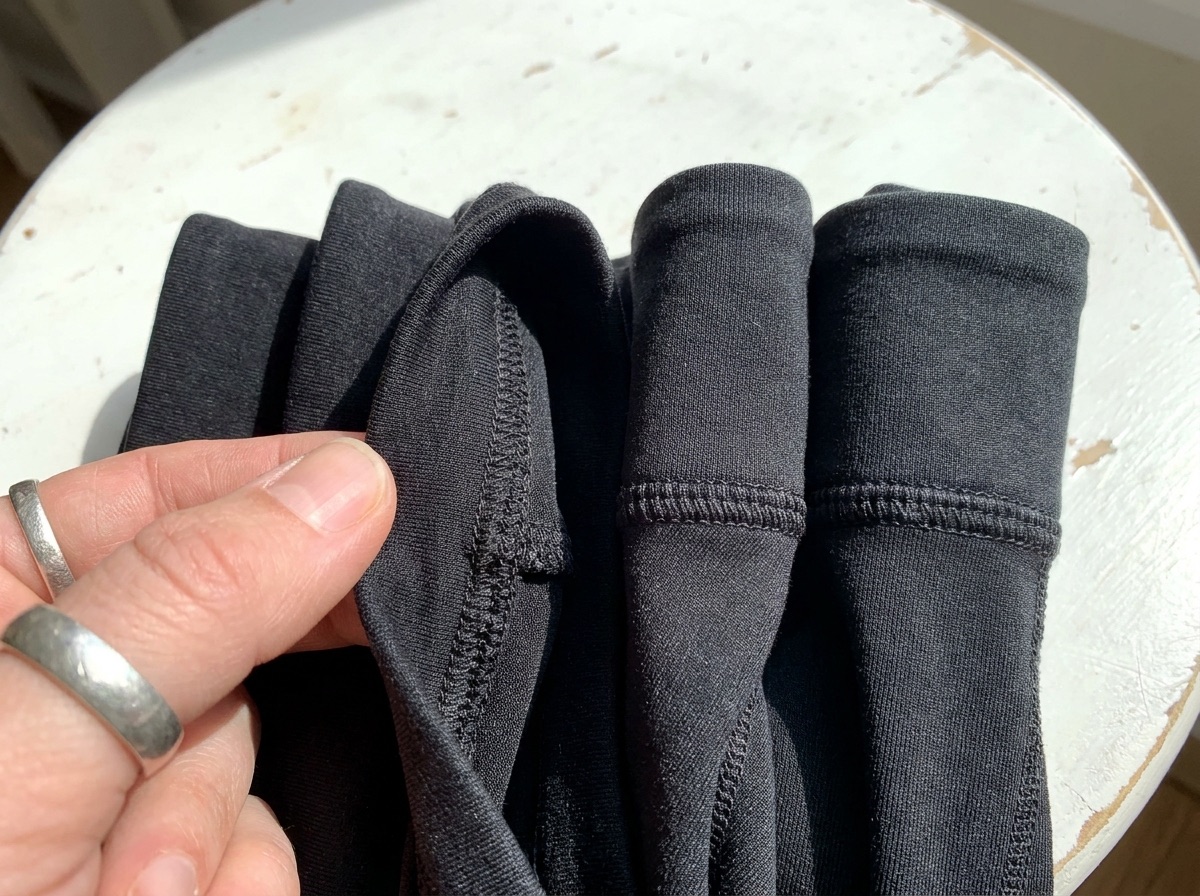
4D compression is a knitted garment that combines graduated compression with a raised three dimensional knit structure whose massage effect is activated by movement. The fourth dimension is time. A flat compression stocking applies broadly the same static pressure whether you are sitting still or walking. A 4D knit adds a raised surface geometry that flexes, compresses and releases against the skin with every step, so the pressure pattern changes continuously as you move.
Is it real or is it marketing? Both, and it matters which part you are asking about. "4D" is a brand label, not a regulated compression class. No standards body certifies a legging as 4D, and no lab measures a garment's "D" count. But the two mechanisms the label describes are real, documented and separately evidenced: graduated compression is one of the best studied interventions in everyday leg care, and movement activated micro massage knit is a patented Italian textile category with pilot level clinical research behind it.
What this guide covers
- Where the D's come from: 1D to 4D
- The graduated compression part, and the evidence
- The micro massage knit, and what is oversold
- What 4D leggings will not do
- Why Japan keeps coming up
- 4D leggings vs compression socks vs medical flat knit
- Seven tests for telling a real pair from a dropshipped one
- Frequently asked questions
- Sources
1. Where the D's come from: 1D to 4D
The dimension language did not start in legwear marketing. It came out of knitting technology, and each step describes a genuine change in how a garment is made.
| Label | What it describes | Where it comes from |
|---|---|---|
| 2D knit | Flat fabric knitted as sheets, then cut and sewn into a tube. Stretch is broadly uniform, seams run up the leg. | Conventional hosiery and legging construction. |
| 3D knit | The garment is knitted as a shaped, seamless three dimensional structure, with surface geometry and pressure zones programmed into the knit itself rather than cut into it. | Shima Seiki of Wakayama, Japan, built the first machine capable of knitting a complete garment in three dimensions without seams in 1995. The company has filed more than 2,900 patents. |
| 4D knit | A textile whose shape or behaviour changes after it is knitted, in response to a stimulus. The fourth dimension is time. | Established usage in textile research. MIT's Self Assembly Lab and Ministry of Supply demonstrated a 4D Knit Dress in 2024 using heat activated yarns that reshape the garment on demand. |
In the research world, the stimulus that triggers the fourth dimension is usually heat or electricity. In compression legwear, the stimulus is simply you. The raised structure is engineered so that walking, climbing stairs and shifting your weight deform it, and that deformation is the point. This is why the better manufacturers in this category are explicit that their garments do most of their work in motion rather than at rest.
So when a legging is sold as 4D rather than 3D, the honest translation is: this is a three dimensional knit whose effect is designed to be movement activated. That is a real distinction. It is also, at present, an entirely self awarded one.
2. The graduated compression part, and the evidence
Strip away the branding and the first half of any 4D legging is graduated compression: pressure that is firmest at the ankle and eases as it travels up the leg. This is the oldest and best documented idea in the category, and the mechanism is well described. Graduated pressure narrows the diameter of superficial veins, which increases the velocity and volume of blood moving back toward the heart, and supports the calf muscle pump.
What is genuinely useful here is that the evidence does not require heavy pressure. Several of the strongest findings sit at the light, over the counter end of the scale:
| Finding | Detail | Study |
|---|---|---|
| 62 to 94 mL | Fluid a healthy lower leg gains over a normal day of sitting and standing, measured morning versus seven hours later. | Partsch et al., Dermatologic Surgery, 2004 |
| 11 to 21 mmHg | Pressure range found able to "reduce or totally prevent" evening leg swelling. Stockings above 10 mmHg also improved subjective symptoms. | Partsch et al., 2004 |
| 15 to 20 mmHg | Over real 12 hour standing shifts, security guards in ordinary socks showed significant muscle fatigue, swelling and discomfort. Both compression groups showed no significant change in any measure, and the lighter level was as effective as the heavier one. | Garcia et al., Human Factors, 2023 |
| 15 to 20 mmHg | Across 116 legs of seated, standing and mixed workers, light compression significantly reduced end of day occupational swelling. | International Journal of Vascular Medicine, 2018 |
| 30 to 65% | Share of people prescribed medical compression stockings who do not wear them as directed, citing pain, heat, difficulty getting them on, and appearance. | CMAJ review of graduated compression stockings |
That last number is the commercial reason this whole category exists. Medical compression works, and between a third and two thirds of the people given it stop wearing it because it is uncomfortable, hot, hard to put on, or looks like a medical device. A comfort grade garment that someone actually wears all day is not competing with a prescription stocking on pressure. It is competing with the prescription stocking that is sitting in a drawer.
3. The micro massage knit, and what is oversold
The second half of the 4D claim is the raised texture. The honest description of what it does is mechanical rather than medical: a three dimensional surface under pressure creates many small contact points instead of one smooth contact plane, and those points shift, load and unload against the skin as the limb moves.
This is not an invented category. "Micromassage" fabric is a real term used by Solidea, an Italian medical hosiery manufacturer operating since 1976, whose patented wave structure knit is built on exactly this principle. Their own framing is worth repeating because it is more honest than most of what is written by the brands that borrowed the idea: the garments give their best when the body is in motion, because that is when the structure works.
There is also one piece of genuine clinical evidence for this specific garment type, and it is worth stating precisely rather than stretching it. In 2024, researchers published a pilot study in the journal Life in which 29 women with lipedema wore light micromassage compression leggings rated 15/21 mmHg for roughly three hours a day for four weeks, alongside exercise. Evoked pain scores in the lower body fell from 3.03 to 0.56, and average limb volume fell by about 7.1%.
4. What 4D leggings will not do
This is where the category earns its gimmick reputation, because a handful of claims get repeated across dozens of near identical storefronts and none of them hold up.
- They do not remove cellulite. Cellulite is structural. Fat lobules herniate through fibrous connective bands under the skin, and those bands tether the surface down into dimples. Durable change requires physically releasing the bands. Compression flattens and visually evens the surface while the garment is on, which is a genuine cosmetic effect, and it ends when the garment comes off. Around 80 to 90% of women past puberty have cellulite. It is normal anatomy, not a disease.
- They do not "boost circulation by 30%". This number appears across the category and traces to no study. The mechanism by which graduated compression assists venous return is well described, but no universal percentage exists in the literature. Treat a specific circulation percentage as a marker of a brand that is inventing figures.
- They are not medical grade unless they are registered and measured. "Medical grade" in the United States generally points at 20 to 30 mmHg and above, with a measured pressure profile. A garment with no published pressure rating is not medical grade regardless of how it is described.
- They do not cure lipedema or lymphoedema. Compression is a genuine pillar of conservative lipedema care, and the 2024 S2k guideline is explicit that the aim is improvement of subjective symptoms, particularly pain. Management is not cure. For a diagnosed condition, fitted flat knit garments prescribed by a clinician remain the standard, and a comfort grade legging is at best a companion for the hours in between.
- They do not tighten loose skin. After major weight loss, stretched collagen and elastin do not fully rebound. Compression garments are recommended after bariatric surgery for comfort, support and reduced chafing, and the clinics that recommend them are clear that they do not prevent or fix excess skin.
- They do not keep their compression forever. Elastane fatigues. The industry's own convention, including from the Italian manufacturer that invented the micromassage category, is replacement every three to six months depending on wear. Heat is what kills the fibre, which is why cold washing and skipping the dryer genuinely matters.
5. Why Japan keeps coming up
A lot of this category is marketed with a Japanese association, and there are two legitimate reasons for it plus one thing to watch for.
The engineering reason. Seamless three dimensional knitting is a Japanese invention. Shima Seiki, based in Wakayama, debuted the first machine able to knit a complete garment in three dimensions with no sewing at the 1995 ITMA trade fair, where it was billed as "the magic of the Orient". The company holds a patent portfolio of more than 2,900 filings. Japan is also home to Asahi Kasei, maker of Roica elastane, one of the stretch fibres used across performance legwear.
The cultural reason. Compression legwear in Japan is an ordinary everyday product rather than a medical one. It is sold as chakuatsu legwear, stocked in mainstream drugstore chains like Matsumoto Kiyoshi alongside cosmetics, and marketed by brands such as Slim Walk, made by the health products manufacturer PIP, and MediQtto. It is bought for mukumi, the everyday word for the leg swelling and heaviness that builds through the day. English has no equivalent single word for it, which is part of why the American market was never really sold a daily fix for it.
6. 4D leggings vs compression socks vs medical flat knit
| Comfort grade 3D/4D leggings | Compression socks | Medical flat knit garments | |
|---|---|---|---|
| Coverage | Foot or ankle to waist, including thigh and hip | Foot to below the knee, in most styles | Made to measure, ankle to waist available |
| Typical pressure | Light, commonly 8 to 20 mmHg where measured at all. Often unpublished. | 8 to 15 or 15 to 20 mmHg over the counter, 20 to 30 medical | 20 to 30 mmHg and upward, measured and certified |
| Knit | Circular knit with raised surface structure | Circular knit, smooth | Flat knit, stiffer, bridges skin folds without cutting in |
| Fitted by | Size chart | Size chart | A trained fitter, to your measurements |
| Best at | All day wearability, end of day heaviness, smoothing under clothes | Targeted lower leg support, travel, work shifts | Managing diagnosed lymphoedema and established lipedema |
| Weak at | Anything requiring a certified pressure. Not a substitute for prescribed compression. | The thigh, which is left unsupported and where a tight cuff can dig in | Comfort, heat, ease of donning, and looking like ordinary clothing |
| Replace every | 3 to 6 months | 3 to 6 months | Per your clinic, usually 6 months |
7. Seven tests for telling a real pair from a dropshipped one
This category has a large number of near identical storefronts selling the same white label garment with different names, so the useful question is not "is 4D real" but "is this seller serious". These are the checks that separate them.
- Does the product page state the fibre composition? A real seller knows what their garment is made of. Most of this category is a polyamide and elastane blend, and the elastane percentage tells you roughly how much compression to expect. Around 10% elastane is comfort grade. True compression hosiery generally runs higher.
- Do they publish a mmHg range, and do they say whether it was measured? The gold standard answer is a lab pressure profile. The acceptable answer is an honest "we have not had these lab tested, so we do not publish a number". The bad answer is silence combined with the words "medical grade".
- Do they claim to remove or reduce cellulite? If yes, they are describing something a garment cannot do. Appearance wording while worn is the honest ceiling, and the responsible manufacturers in this category stay inside it.
- Is there a specific percentage attached to circulation? There is no such published figure. Its presence tells you the copy was written backwards from a sales target.
- Do they say "clinically tested" without naming the study? A real study has authors, a journal and a year. If those are missing, the phrase was borrowed.
- Do they tell you the garment wears out? Honest sellers say replace every three to six months, because elastane fatigues. Sellers promising permanent compression are telling you they do not know the product.
- Do they tell you not to sleep in them? Daytime compression is designed for an upright, moving body. A seller encouraging you to wear a compression garment overnight without a clinician saying so is a seller optimising for wear time rather than for you.
The verdict
4D compression is not a gimmick, and it is not medicine. It is a real construction, honestly summarised as a graduated compression legging with a movement activated three dimensional knit, sold under a self awarded label with no governing standard behind it.
Judged as a comfort grade daily garment for heavy, tired, swollen feeling legs and for smoothing under clothes, the mechanisms are sound and the category evidence supports the claim at even light pressures. Judged as a treatment for cellulite, loose skin or a diagnosed lymphatic condition, it fails, and the brands making those claims are the reason the whole category gets called a scam.
Buy it for what it is: the compression you will actually wear.
The pair we tested in this category, and the one whose manufacturer publishes its construction openly, is the Sira Sculpt 4D compression legging. Their own technical breakdown of the knit, the fibre composition and the claims they decline to make is worth reading alongside this guide.
Frequently asked questions
Are 4D leggings real or a gimmick?
Both halves of that question have different answers. The term "4D" is marketing: there is no 4D compression standard and no certification behind it. The construction it describes is real: a graduated compression garment with a raised three dimensional knit whose effect is activated by movement. The mechanisms are documented. The label is not regulated.
What does the 4D in 4D compression actually mean?
The fourth dimension is time. In textile engineering, a 4D textile is one whose shape or behaviour changes after it is knitted, in response to a stimulus. In compression legwear the stimulus is your own movement, so the raised knit compresses and releases against the skin as you walk rather than applying a single static pressure.
Is 4D compression better than 3D compression?
Not necessarily, and often they describe the same garment. 3D refers to the knit structure being three dimensional. 4D adds the claim that the structure is designed to work in motion. Because neither term is standardised, the labels tell you less than the fibre composition, the pressure rating and whether the seller publishes either.
How many mmHg is 4D compression?
There is no fixed answer, which is the central problem with the label. Comfort grade garments in this category typically sit in the light range, roughly 8 to 20 mmHg where they are measured at all, and many sellers never publish a figure. Published research on evening leg swelling found that 11 to 21 mmHg was enough to reduce or prevent it, so light pressure is not automatically useless. It just needs to be stated.
Do 4D compression leggings work for lipedema?
Compression is a recognised pillar of conservative lipedema care, aimed at relieving symptoms such as pain, heaviness and swelling rather than curing the condition. A 2024 pilot study of 29 women using light micromassage compression leggings for four weeks reported significantly reduced pain and about 7.1% lower limb volume, though it had no control group. For diagnosed lipedema, fitted flat knit compression prescribed by a clinician remains the standard, and a comfort grade legging is best treated as a companion rather than a replacement.
Can 4D leggings get rid of cellulite?
No. Cellulite is caused by fibrous bands tethering the skin over herniating fat lobules, and no garment changes that structure. Compression plus a dense opaque knit genuinely smooths and evens how skin looks while the leggings are worn, and the effect ends when they come off. Roughly 80 to 90% of women past puberty have cellulite and it is a normal anatomical variant.
Can you sleep in compression leggings?
Daytime compression garments are designed for an upright, moving body, and the movement activated design of a 3D or 4D knit does nothing while you are lying still. Unless a clinician has specifically told you otherwise, take them off at night.
How long do 4D compression leggings last?
Plan on three to six months of regular wear before the compression noticeably fades. Elastane loses recovery over time and heat accelerates it, so washing cold and air drying rather than tumble drying meaningfully extends the useful life.
Are 4D leggings the same as medical compression?
No. Medical compression garments are pressure rated, usually 20 to 30 mmHg or above, and for established lymphatic conditions are flat knit and fitted to your measurements by a trained fitter. Comfort grade 3D and 4D leggings are circular knit, sized off a chart and generally much lighter. They are not a substitute for prescribed compression.
Why are 4D leggings marketed as Japanese?
Two real reasons. Seamless three dimensional knitting was invented in Japan, by Shima Seiki of Wakayama, which built the first whole garment 3D knitting machine in 1995. And compression legwear is an everyday consumer product in Japan, sold in mainstream drugstores as chakuatsu legwear and bought for mukumi, the ordinary word for end of day leg swelling. That describes an approach, not necessarily where a given garment was manufactured.
Sources
- Partsch H, et al. "Light compression stockings and evening leg oedema." Dermatologic Surgery, 2004. PMID 15099316
- Garcia J, et al. "Effects of compression stockings on lower limb fatigue and oedema during prolonged standing work." Human Factors, 2023. PMID 34078143
- "Compression stockings for occupational leg oedema." International Journal of Vascular Medicine, 2018. PMC6188858
- "Graduated compression stockings." CMAJ review. PMC4081237
- Ricolfi L, et al. "Effects of micromassage compression leggings in women with lipedema." Life, 2024. PMID 39063608
- Faerber G, et al. "S2k guideline lipedema." JDDG, 2024. PMID 39188170
- Bass LS, Kaminer MS. "Insights into the pathophysiology of cellulite." Dermatologic Surgery, 2020. PMID 32976174
- Luebberding S, et al. "Cellulite: an evidence based review." American Journal of Clinical Dermatology, 2015. PMID 25940753
- Shima Seiki. "History of WHOLEGARMENT." shimaseiki.com
- MIT Self Assembly Lab and Ministry of Supply, 4D Knit Dress, 2024. Dezeen coverage
- Solidea. "Micromassage fabric." solidea.com
- American Academy of Dermatology. "Cellulite treatments: what really works." aad.org